Japanese Particle List: The Four Categories at a Glance【助詞リスト】
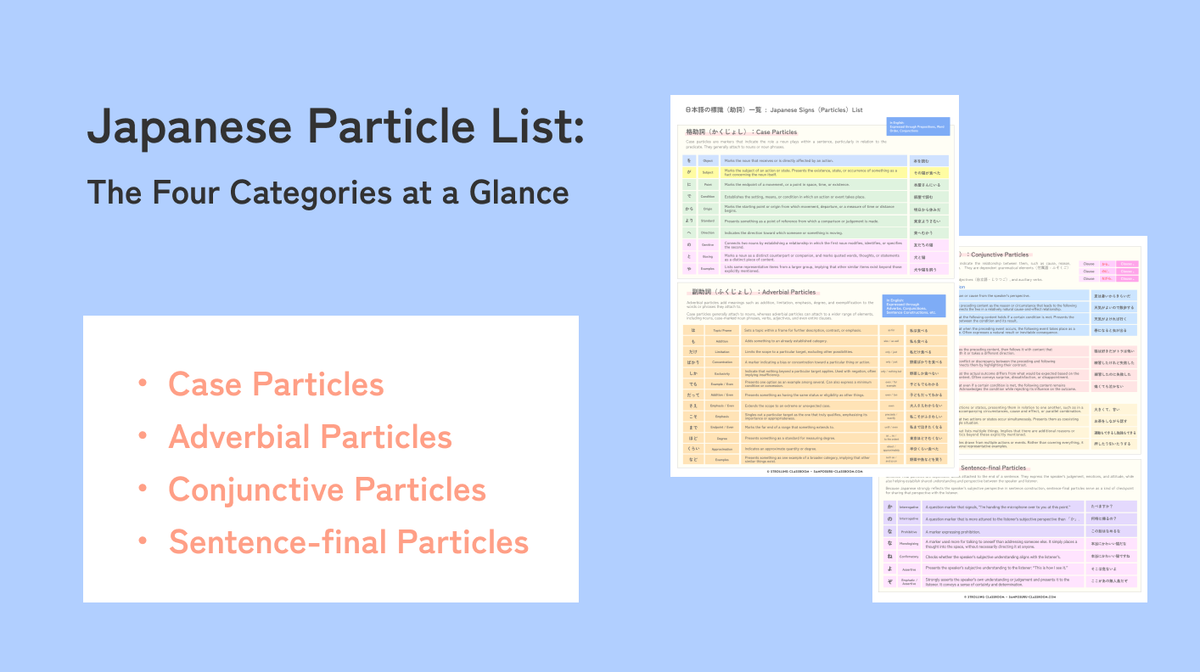
I'm sharing a two-page list of Japanese particles with all members.
The first page covers case particles and adverbial particles, and the second covers conjunctive particles and sentence-final particles.
How particles are actually used can be hard to grasp from these sheets alone. You don't need to memorise everything at the start. Please use them when you come across a particle for the first time, or when you want to check a particle's core nuance. Simply browsing them to see what other particles exist is also recommended.
Particles are words that can't be used on their own (dependent words, 付属語). They attach after other words and show what role those words play in the sentence and which direction the sentence is heading. In Japanese, particles control the direction of a sentence, and finer adjustments are made with the ending of the predicate.
There are several kinds of particles, and each kind differs in what it attaches to and what it does. Here is a brief explanation of the four categories in the sheets.
✅格助詞(かくじょし): Case Particles
Case particles are markers that show what role a noun plays in relation to the predicate. They basically attach to nouns.
In 「本を読む」, 「を」 shows that the book is what receives the action of reading, and in 「部屋で読む」, 「で」 shows that the room is the setting of that action.
In English, these roles are expressed through prepositions, word order, and so on. In other words, what English expresses by other means is carried in Japanese by small markers placed after nouns.
Case particles in the sheet: を・が・に・で・から・より・へ・の・と・や
✅副助詞(ふくじょし): Adverbial Particles
Adverbial particles are markers that add meanings such as addition, limitation, emphasis, degree, and exemplification to the words they attach to.
While case particles basically attach to nouns, adverbial particles can attach not only to nouns but also to case-marked nouns, verbs, adjectives, and even entire clauses.
In English, these meanings are often expressed through adverbs, conjunctions, or sentence constructions.
「は」 also belongs to this category. 「が」 is a case particle, so 「は」 and 「が」 are different kinds of particles to begin with. I explain this difference in detail in this video:→は vs が https://youtu.be/vtAqyIp6rKY
Adverbial particles in the sheet: は・も・だけ・ばかり・しか・でも・だって・さえ・こそ・まで・ほど・くらい・など
✅接続助詞(せつぞくじょし): Conjunctive Particles
Conjunctive particles are markers that connect clauses and show the relationship between them. They attach to the inflected forms of verbs, adjectives, and auxiliary verbs.
In the sheet, they are divided into three groups by type of relationship:
Consequence, Reason, and Condition: から・ので・ば・と
Contrast and Concession: が・けれど・のに・ても
Connection and Enumeration: て・ながら・し・たり
「が」 and 「と」 also appear among the case particles. Even with the same form, they work as different particles depending on whether
✅終助詞(しゅうじょし): Sentence-final Particles
Sentence-final particles are markers attached to the end of a sentence that express the speaker's judgement, feelings, and attitude. At the same time, they help the speaker and listener share understanding and perspective.
Japanese is a language in which the speaker's subjective perspective is strongly reflected in how sentences are built. That is why sentence-final particles serve as a kind of "checkpoint" for sharing that perspective with the listener.
Sentence-final particles in the sheet: か・の・な・ね・よ・ぞ
👇If you're not a member yet, you can sign up for free and get these sheets!