Japanese Adjective Expressions and Attributive Modification
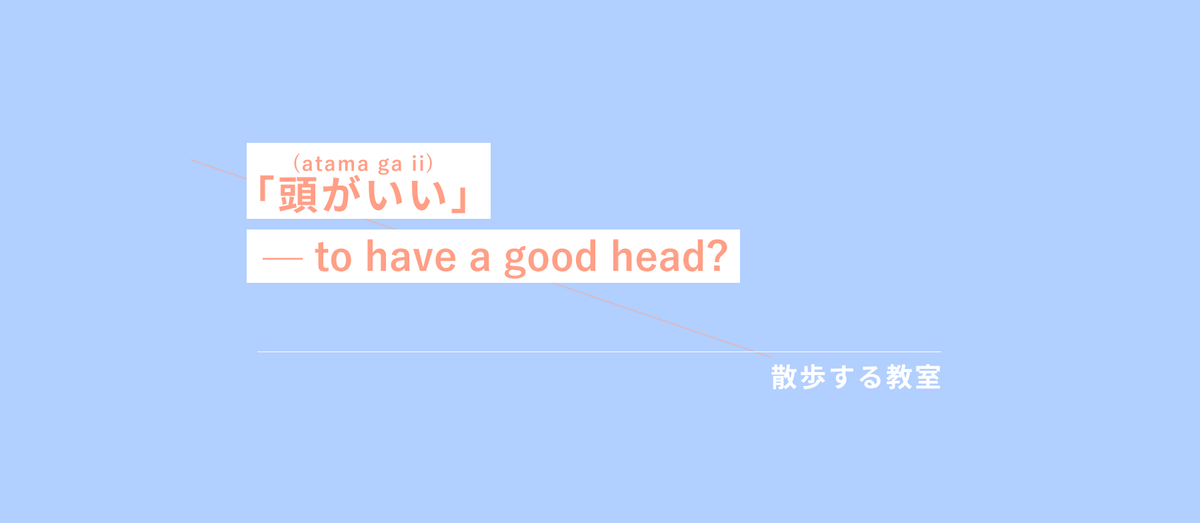
「頭がいい」(atama ga ii) — to have a good head = to be intelligent / smart
「足が速い」(ashi ga hayai) — to have fast feet = to be able to run fast
Grammatically, these sentences are treated as i-adjective predicate sentences in the form of “noun + が + i-adjective.”
Let's break them down:
頭がいい (atama ga ii): Head is good = intelligent / smart
- 頭 (atama): head (noun)
- が (ga): subject marker
- いい (ii): good (い-adjective)
足が速い (ashi ga hayai): Feet are fast = can run fast
- 足 (ashi): foot, feet, leg (noun)
- が (ga): subject marker
- 速い (hayai): fast, quick (い-adjective)
These are indeed adjective sentences with a subject and an adjective. However, I think there is value in learning many of these expressions as single adjective expressions.
For example:
- 頭がいい (atama ga ii) → intelligent / smart
- 足が速い (ashi ga hayai) → fast
- 背が高い (se ga takai) → tall
- 仲がいい (naka ga ii) → close
- 気が強い (ki ga tsuyoi) → strong-willed
- 可能性が高い (kanosei ga takai) → likely / probable
- 蓋然性が高い (gaizensei ga takai) → highly probable
While these can often be expressed using a single adjective or an adjective phrase in English, Japanese uses the structure “noun + が + adjective.”
Grammatically, they are adjective predicate sentences, but many of them also function as conventionalised expressions that have effectively become single adjective expressions.
I think a lot of you may find it easier to use these expressions naturally if they understand the Japanese grammatical structure while also learning each expression as a single unit of vocabulary.
Building vocabulary through combinations
One advantage of this pattern is that even when the vocabulary becomes more advanced, the adjective used in the combination is often a basic one. This means that learners may only need to learn the noun at the beginning of the expression.
This is somewhat similar to how the verb する (suru) combines with various nouns and onomatopoeic expressions to create a wide range of meanings.
- 運動する (undou suru) → to exercise
- 勉強する (benkyou suru) → to study
- 思案する (shian suru) → to contemplate
- 上京する (jokyou suru) → originally, to travel to the capital (京 - miyako); nowadays, in most cases, to go to Tokyo, 東京.
- サクサクする (sakusaku suru) → to be crispy / crunchy
- もちもちする (mochimochi suru) → to be chewy / soft and springy
- ふわふわする (fuwafuwa suru) → to be fluffy / feel light and airy
- ドキドキする (dokidoki suru) → to feel one's heart pounding / to be nervous or excited
In the examples before, 背が高い (se ga takai) is a basic expression used to describe someone who is tall. However, 蓋然性が高い (gaizensei ga takai) uses vocabulary that even some native Japanese speakers may not know.
Perhaps this is one of the interesting characteristics of Japanese: its ability to create vocabulary through combinations of individual components.
Two broad types of these expressions
These expressions can broadly be divided into the following two categories.
1. Expressions that strongly retain the meaning of “noun + adjective”
Sentences describing the characteristics of a particular body part or feature:
- 髪が長い (kami ga nagai) → to have long hair
- 目が大きい (me ga ookii) → to have big eyes
- 手が小さい (te ga chiisai) → to have small hands
2. Expressions that function more like a single adjective expression
Conventionalised expressions describing various characteristics and qualities:
- 頭がいい (atama ga ii) → intelligent / smart
- 足が速い (ashi ga hayai) → fast
- 仲がいい (naka ga ii) → close
Abstract expressions of evaluation:
- 可能性が高い (kanosei ga takai) → likely / probable
- 確率が低い (kakuritsu ga hikui) → unlikely / improbable
- 蓋然性が高い (gaizensei ga takai) → highly probable
Of course, these two categories are not completely separate. However, I think this distinction can be useful when learning them as vocabulary.
Can が be replaced with の? — Genitive Subjects and Attributive Modification
There is another interesting feature of these expressions: in some cases, が can be replaced with の.
This is a grammatical phenomenon known as the genitive subject の (shukaku no) in Japanese.
Normally, の is used as a particle connecting two nouns, as in 私の本 (watashi no hon, my book) or 日本の文化 (Nihon no bunka, Japanese culture). However, under certain conditions, it can also function like が, marking the subject within a clause.
For example:
- 頭がいい人 (atama ga ii hito) → 頭のいい人 (atama no ii hito) — a person who is intelligent
- 背が高い人 (se ga takai hito) → 背の高い人 (se no takai hito) — a tall person
- 足が速い犬 (ashi ga hayai inu) → 足の速い犬 (ashi no hayai inu) — a dog that can run fast
- 可能性が高い話 (kanosei ga takai hanashi) → 可能性の高い話 (kanosei no takai hanashi) — a story with a high probability
- 蓋然性が高い判断 (gaizensei ga takai handan) → 蓋然性の高い判断 (gaizensei no takai handan) — a highly probable judgement
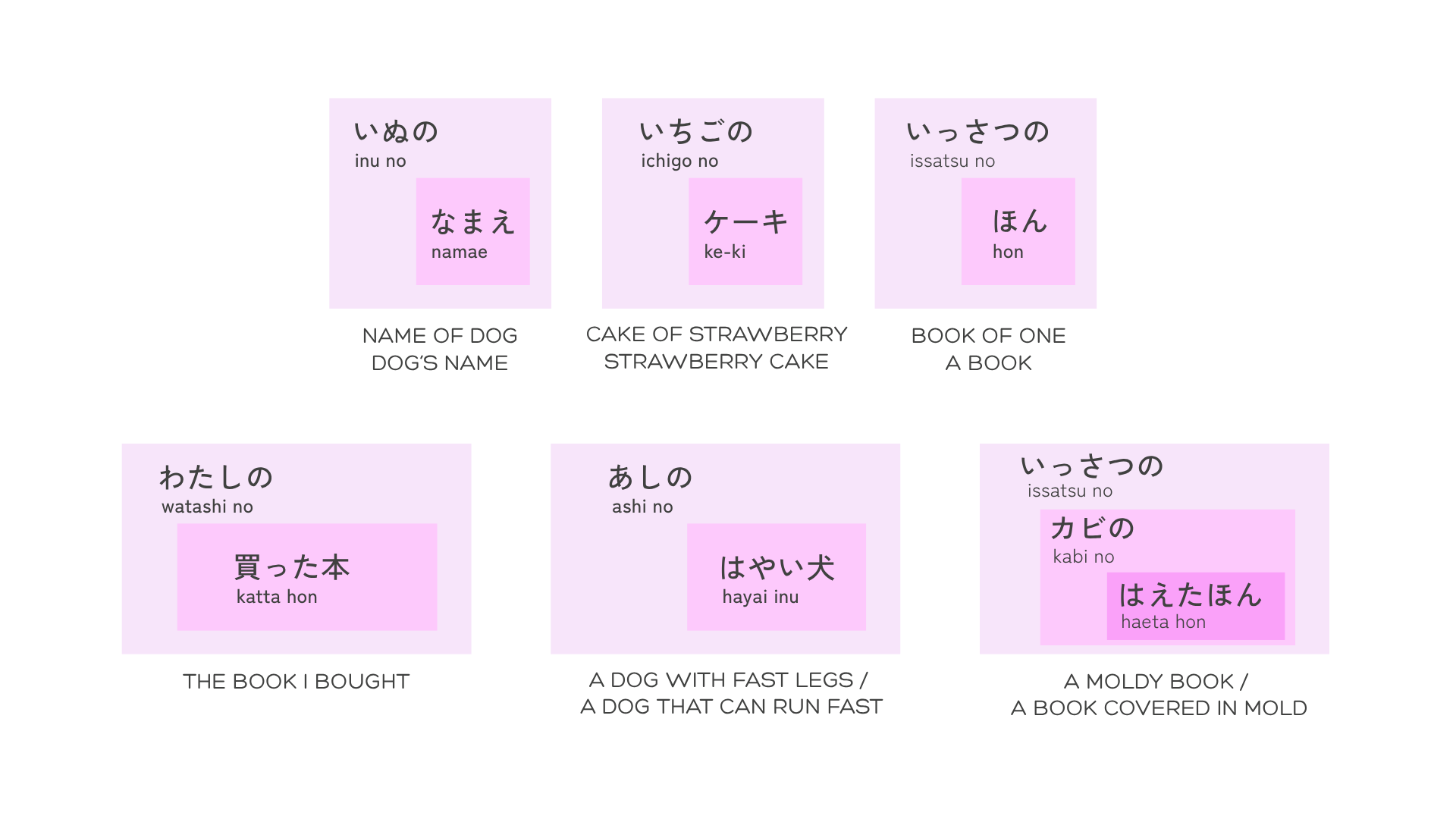
In these examples, の is not simply connecting two nouns. Instead, the nouns 頭 (atama), 背 (se), 足 (ashi), 可能性 (kanosei) and 蓋然性 (gaizensei) function as the subjects of the following adjectives.
One of the typical environments in which genitive subject の appears is inside an attributive modification clause (a clause that modifies a noun).
This phenomenon is not limited to adjective sentences. It can also occur in clauses containing verbs.
- 私が買った本 (watashi ga katta hon) → 私の買った本 (watashi no katta hon) — the book I bought
- 一冊のカビが生えた本 (issatsu no kabi ga haeta hon) → 一冊のカビの生えた本 (issatsu no kabi no haeta hon) — a book with mould growing on it
However, not every が can be replaced with の. Even when the substitution is grammatically possible, how natural it sounds can vary depending on the structure of the clause and the type of predicate.
The important point is that の cannot be freely exchanged with が in ordinary sentences.
For example:
- 私は足が速い 。(watashi wa ashi ga hayai.) → ❌️ 私は足の速い 。(watashi wa ashi no hayai.)
- 背が高い。 (se ga takai.) → ❌️ 背の高い。 (se no takai.)
- 可能性が高い。 (kanosei ga takai.) → ❌️ 可能性の高い。 (kanosei no takai.)
As you can see, when there is no noun following the expression to be modified, genitive subject の generally cannot be used.
If someone said 「私は足の速い (watashi wa ashi no hayai)」, I would naturally expect them to continue with a noun. My reaction would probably be: “Fast... what?”
If the sentence really ended there, we would describe it in Japanese as 尻切れトンボ (shirikire tonbo, literally something like “a dragonfly with its tail cut off”).
It describes something that ends abruptly or feels incomplete, without a proper conclusion.
For another example, 口が汚い人 (kuchi ga kitanai hito, a person who uses vulgar language) can also be expressed as 口の汚い人 (kuchi no kitanai hito).
However, you cannot say: ❌️あの人は口の汚い 。(ano hito wa kuchi no kitanai.)
The grammatically correct sentence is:あの人は口が汚い (ano hito wa kuchi ga kitanai). — That person uses vulgar language.
On the other hand, you can say:
なんて口の汚い…… (nante kuchi no kitanai...) — What a foul-mouthed...
This is an intentionally incomplete sentence. The noun and the rest of the sentence , like 「人だ」「男だ/女だ」「子どもだ」etc, are left unsaid.
なんて口の汚い人だ (nante kuchi no kitanai hito da) — What a foul-mouthed person.
Genitive subject の can sometimes be used in place of が to mark the subject within a clause that modifies a noun.
Try incorporating these expressions into your vocabulary practice!
Japanese has many conventionalised expressions of this kind, and they are used very frequently in everyday conversation.
I encourage you to incorporate these combinations into your vocabulary practice!
In the adjective section of my app, I have recently added a new section where you can focus specifically on adjective vocabulary, in addition to practising conjugations.
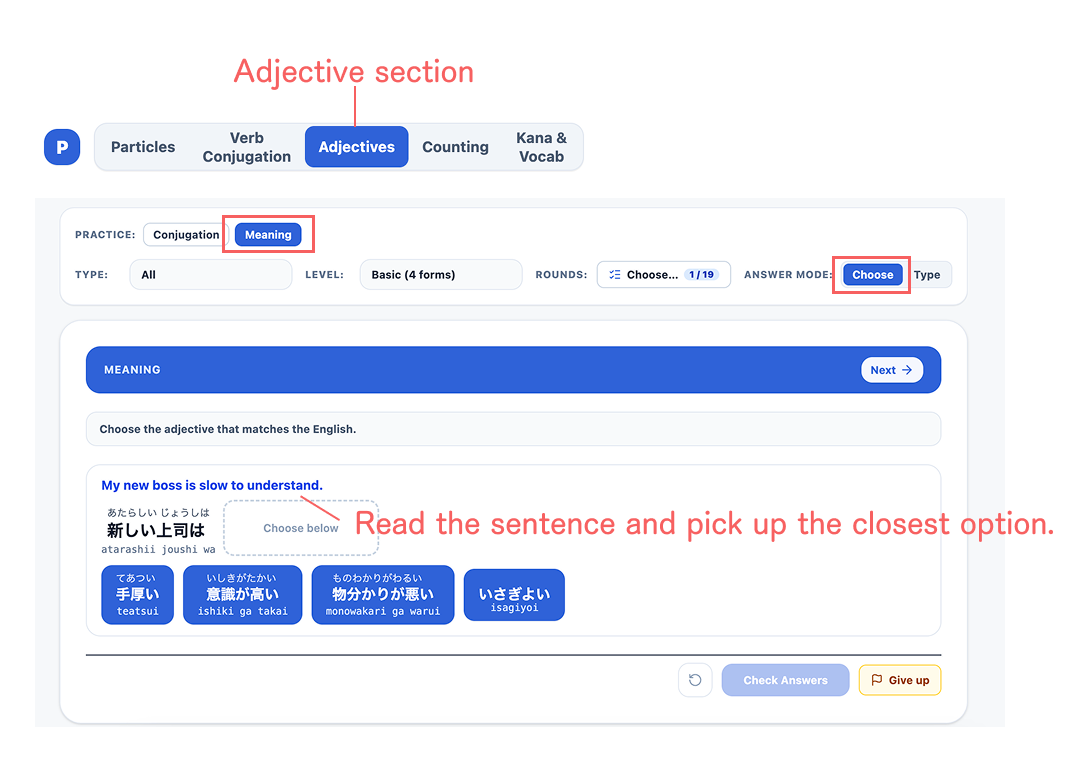
It's still a little tricky to use in some places, but I have included many of these characteristically Japanese “noun + が + adjective” expressions.
I've expanded the vocabulary to include words up to approximately the N3–N2 level, so please give the new い-adjective section a try!