How to Think in Japanese: Why Particles Are the Real Key
Studied Japanese for years but still can't speak it? Learn how to "think in Japanese" by focusing on particles — the trail markers that guide every sentence to its meaning.
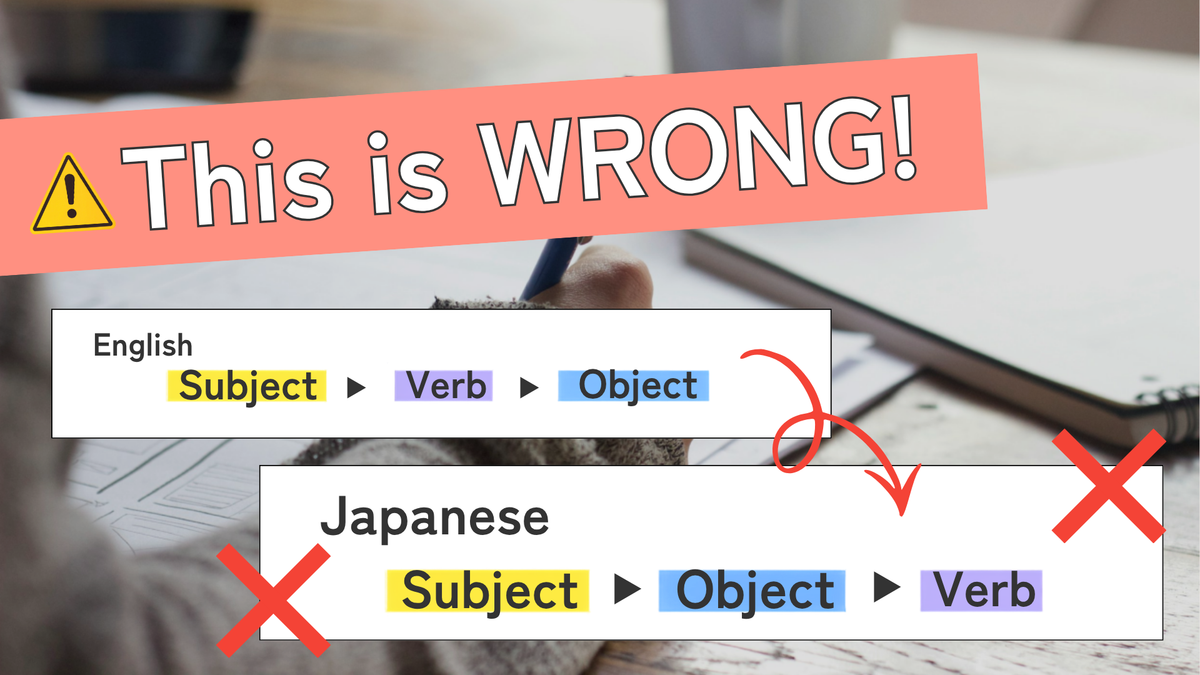
How do you picture Japanese word order? In English it runs subject → verb → object. Are you just flipping that around and trying to memorize "Japanese is subject → object → verb"?
If you've been studying Japanese for a long time but still don't feel like you can actually speak it, the reason is often this: you're trying to learn Japanese without ever stepping away from the way your native language works.
People often say, "Stop thinking in your native language and start thinking in Japanese." But what does it actually mean to think in Japanese? There are countless resources explaining Japanese grammar, but very few that explain this specifically Japanese way of thinking in the first place. That's why I wanted to write this.
Here, I'll explain some key characteristics of Japanese by comparing it with English. Especially if your first language is an Indo-European language, these are the points I really want you to understand before you go any further.
If you find the text difficult to read, I’ve also made an explanation video, so please feel free to watch it here.
First, let's look at the world of English
Many European languages, including English, build their sentences around the relationship between the subject and the verb.
- I eat.
- I drink.
- I sleep.
You start from this subject-and-verb unit, and then you can add an object, add a complement, or keep extending it with relative clauses.
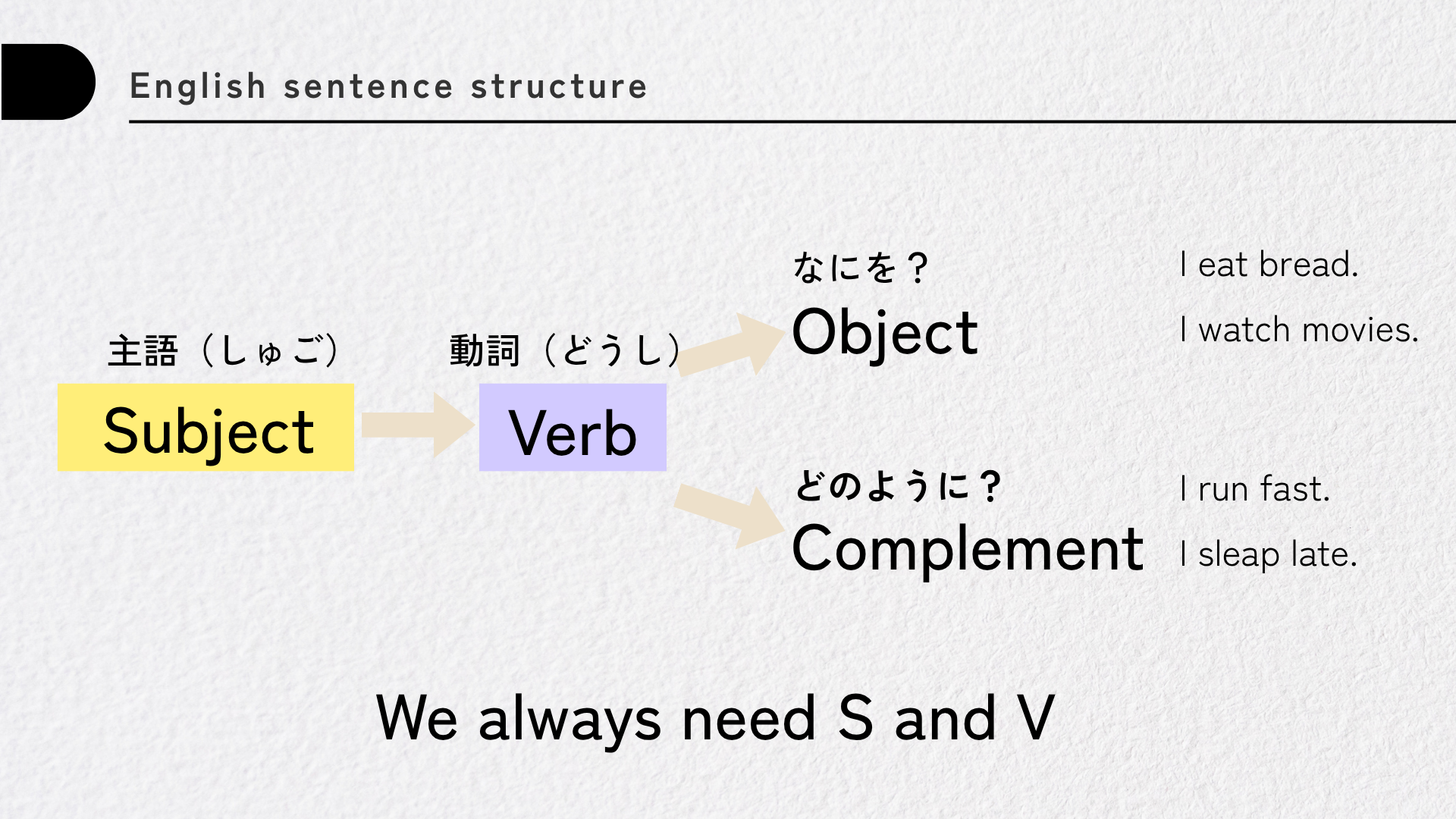
No matter how complicated the sentence becomes, the subject and the verb are the key elements — they're the starting point. In English, you always need a subject and a verb.
When I was studying English by myself, English felt like a language where you cross a river by jumping from stepping stone to stepping stone.
Imagine you want to get from the left bank to the right bank. You have your starting point and the far side you're trying to reach.
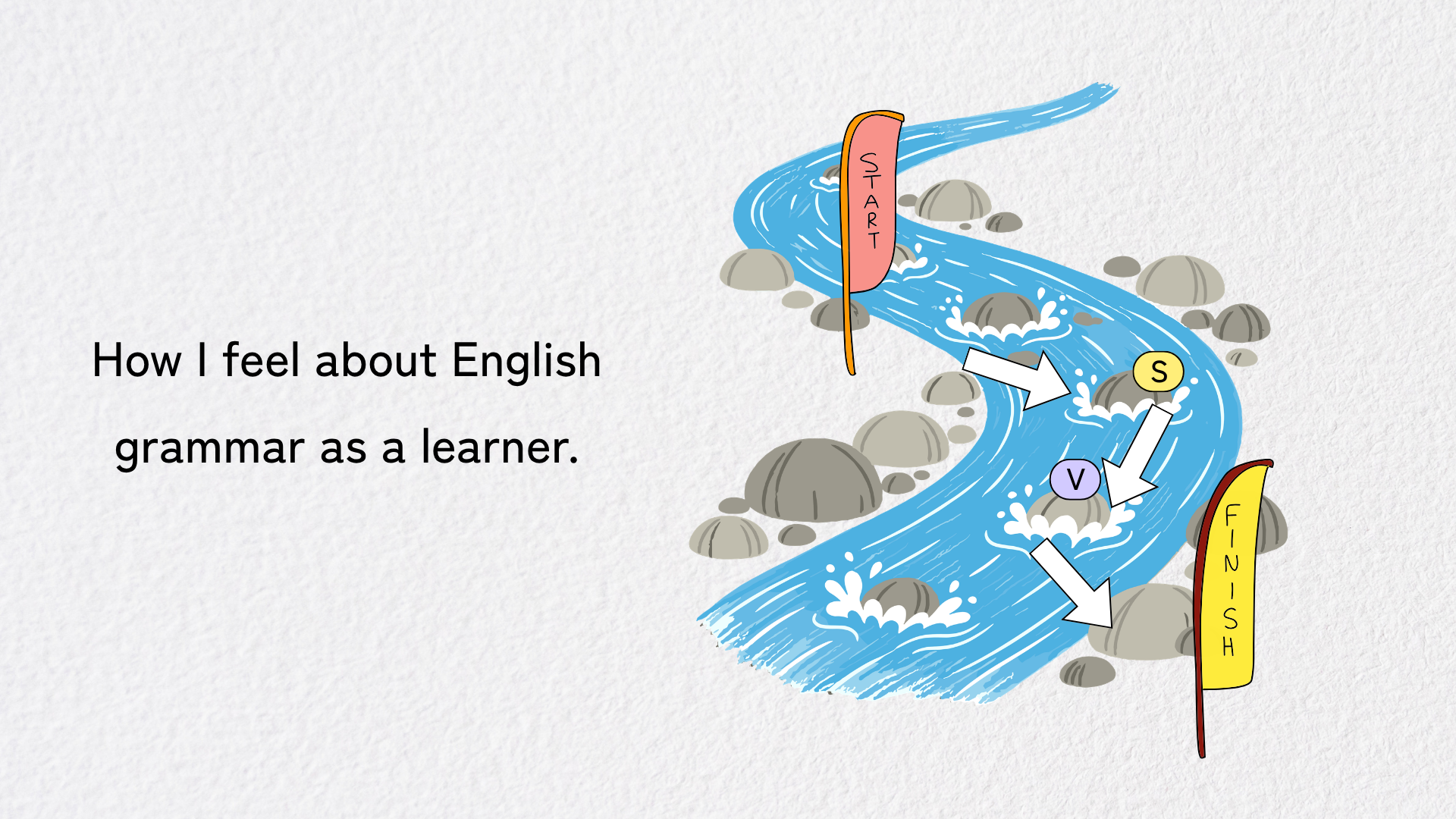
In between, you have to work out which stone to put your right foot on first — that's the subject. Then you jump to the next stone with your left foot — that's the verb. Finally you land on the far bank with both feet — that's your goal.
People with lots of stepping stones — a big vocabulary, lots of sentence patterns — seem to speak English fluently, because they have more places to step. Honestly, even now I often can't find the next stone in the middle of the river, and I end up falling straight in.
In Japanese, the subject and verb matter less
So the subject and the verb are very important in English. Japanese has subjects and verbs too, of course — but in terms of how important they are, they simply aren't as central as they are in English.
The subject marker in Japanese is が. But look at this sentence:
わたしは まり です。 — I'm Mari.
There's no subject here, and no verb. People often say Japanese frequently leaves the subject out — and the fact that you don't have to say it every time is already a hint that it isn't that important. The same goes for verbs.
The predicate (述語) and the four sentence types
Broadly speaking, Japanese has four sentence types: noun sentences, verb sentences, i-adjective sentences, and na-adjective sentences. Nouns, verbs, i-adjectives, and na-adjectives can all serve as the predicate of a sentence.
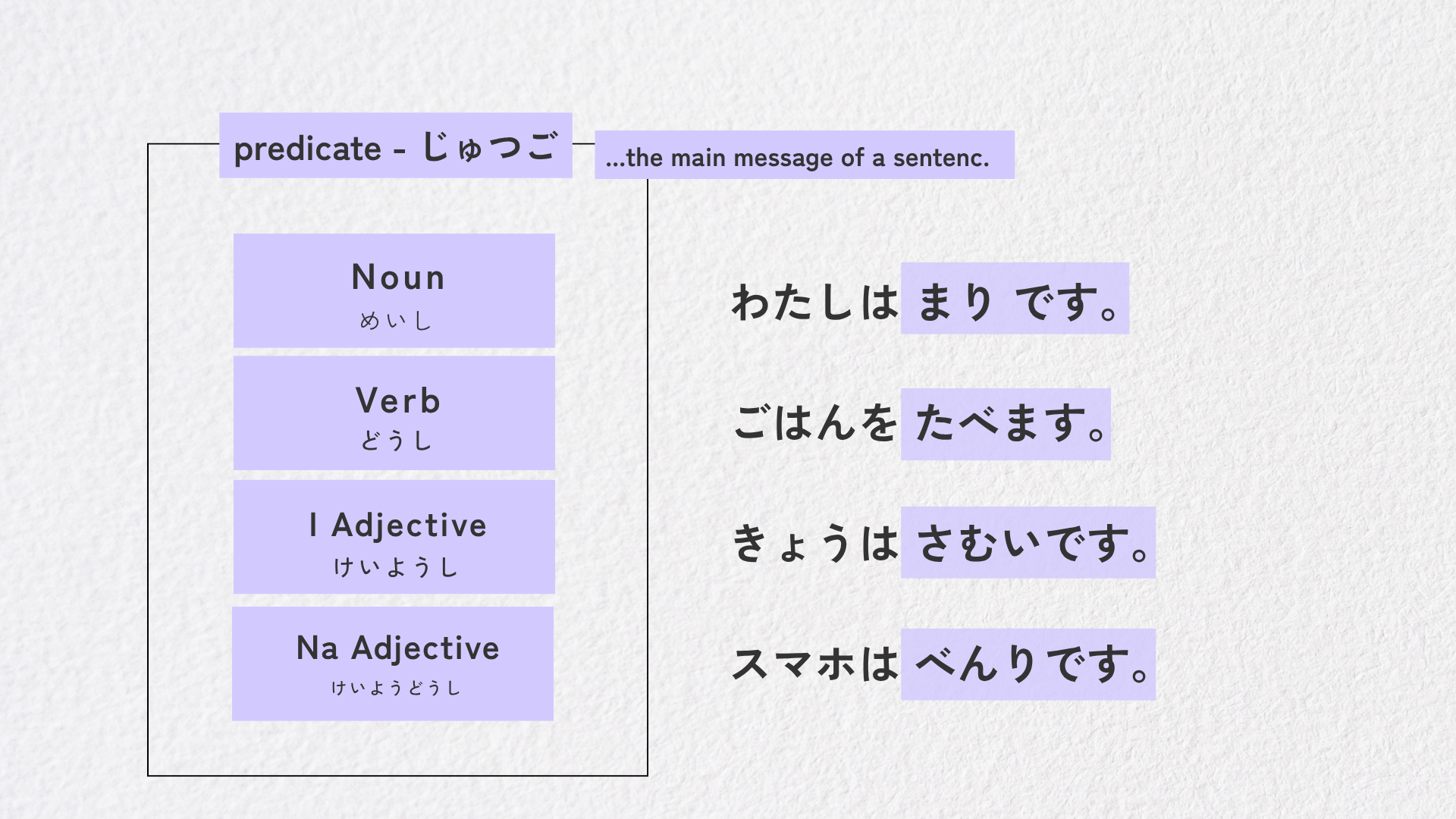
The predicate is the main message — the part that tells us what something is like, or what something does.
- わたしは まり です。 → the predicate is まり, the part that tells us what I am.
- ごはんを たべます。 → the predicate is たべます, "eat."
So a verb is only one of the four kinds of predicate, which means verbs are less central than they are in English. That's why, if English is a language of subjects and verbs, Japanese is often described as a language of subjects and predicates.
The real key to thinking in Japanese: the particles
That description is true as far as it goes: a verb is just one of the four predicates. But personally, I think what really corresponds to the subject and verb in English is something else — the particles.
Japanese sentences develop around their particles.
Particles are the stones in Hansel and Gretel
Think about the stones in Hansel and Gretel. The children are left behind in the forest, and they drop stones as markers so they can follow them back home. In the end, they use breadcrumbs instead — and that's exactly why they get lost.
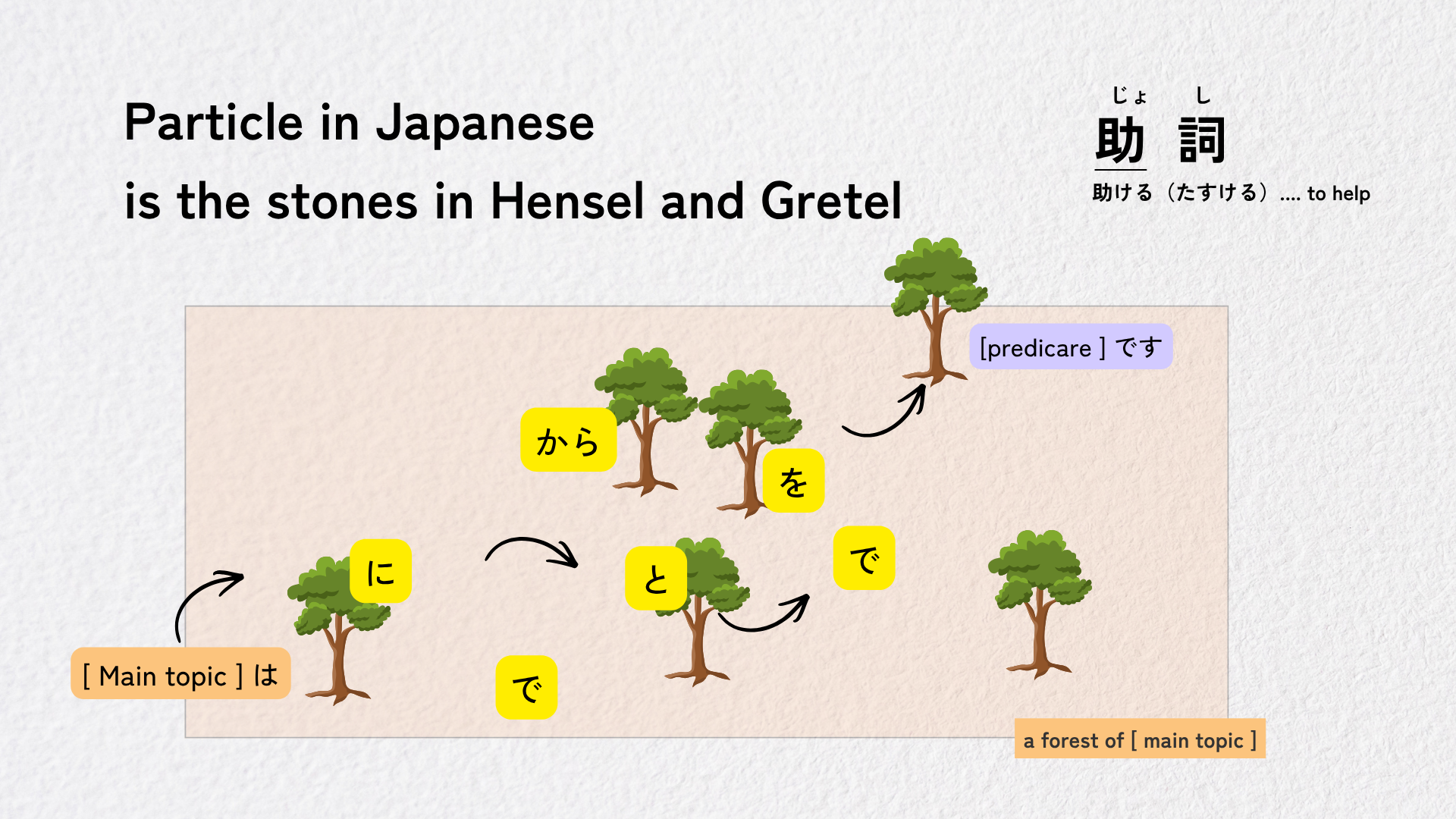
Japanese particles are like those trail-marking stones. That's actually why we call them topic markers, subject markers, and object markers. And the Japanese word for particle, 助詞, literally carries the meaning of a "helping word" — from 助ける, to help.
Particles are there to help us get home. They guide us toward the thing we actually want to say: the predicate, waiting at the end of the sentence.
How a Japanese sentence unfolds
Take this sentence:
わたしは、ともだちと、カフェで、コーヒーを、のみました。 — I drank coffee with a friend at a café.
Listen to how it unfolds, one particle at a time:
- わたしは… — okay, this person is talking about themselves.
- ともだちと… — ah, they did something with a friend.
- カフェで… — something happened at a café.
- コーヒーを… — they did something to coffee.
- のみました… — we've reached the goal!
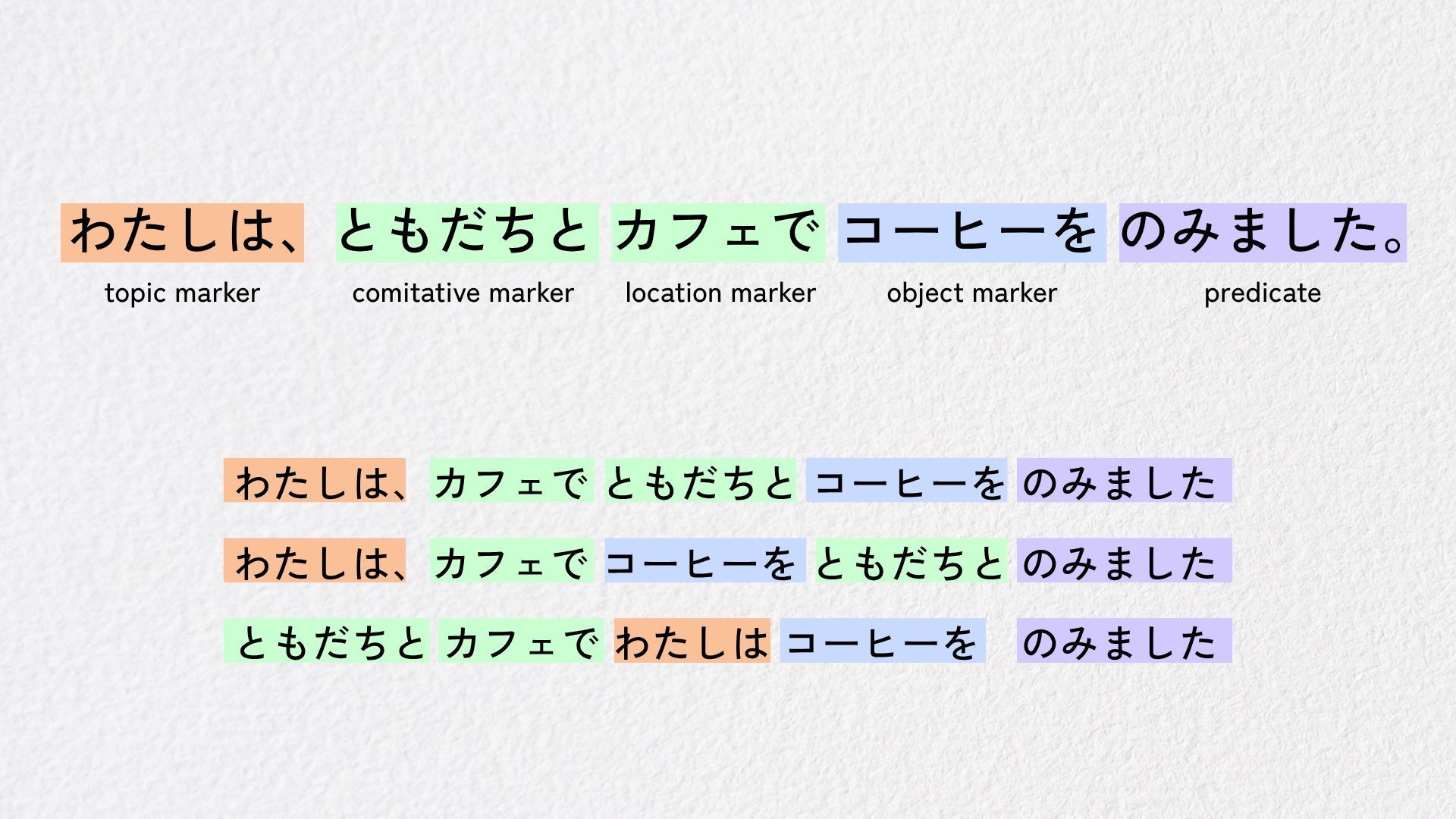
Japanese word order is relatively flexible, as long as the predicate comes at the end. Every one of these is grammatically correct:
- わたしは、カフェで ともだちと コーヒーを のみました。
- わたしは、カフェで コーヒーを ともだちと のみました。
- ともだちと カフェで わたしは コーヒーを のみました。
This works precisely because of the particles. They set the structure of the sentence — the path you follow — and navigate you all the way to the conclusion. So no matter how long the sentence gets, or how much the word order is shuffled around, you can still find your way to the end.
Miss the particles, and you get lost
The flip side is this: if you don't really understand the navigation the particles give you, then the moment a sentence gets even slightly complicated, you suddenly lose your way.
With a simple sentence, you can still get the rough meaning even with no particles at all:
- わたし、ごはん、たべる。 — me, rice, eat.
- おかね、かせぐ、わたしはスター。 — money, earn, I'm a star.
We can understand these even without proper structure. In casual conversation we often drop particles and still understand each other — it's like not needing a map on the walk you take every single day. But when you have a slightly more complicated route to follow, you check the map properly, or you follow the signs, right?
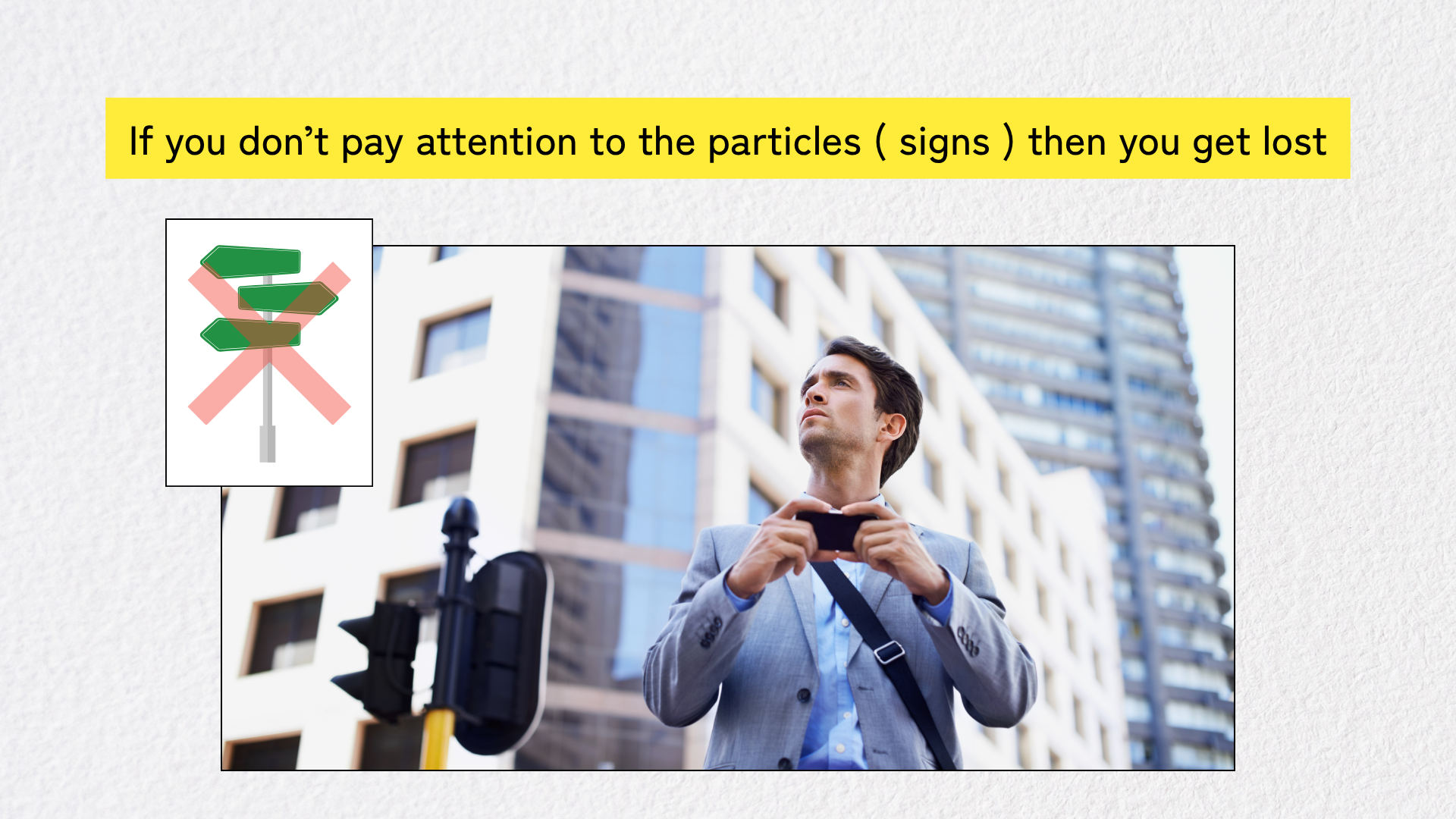
And I think you can probably see, now, why some people study Japanese as hard as they can and still don't become able to speak it.
Put your focus on particles
As long as you study Japanese through an English way of thinking, you'll never really notice how important the particles are. Learners who have just started lessons with me often skip right over them — and not only when they're trying to say something themselves, but even when they're just reading a sentence out loud that's sitting right in front of them.
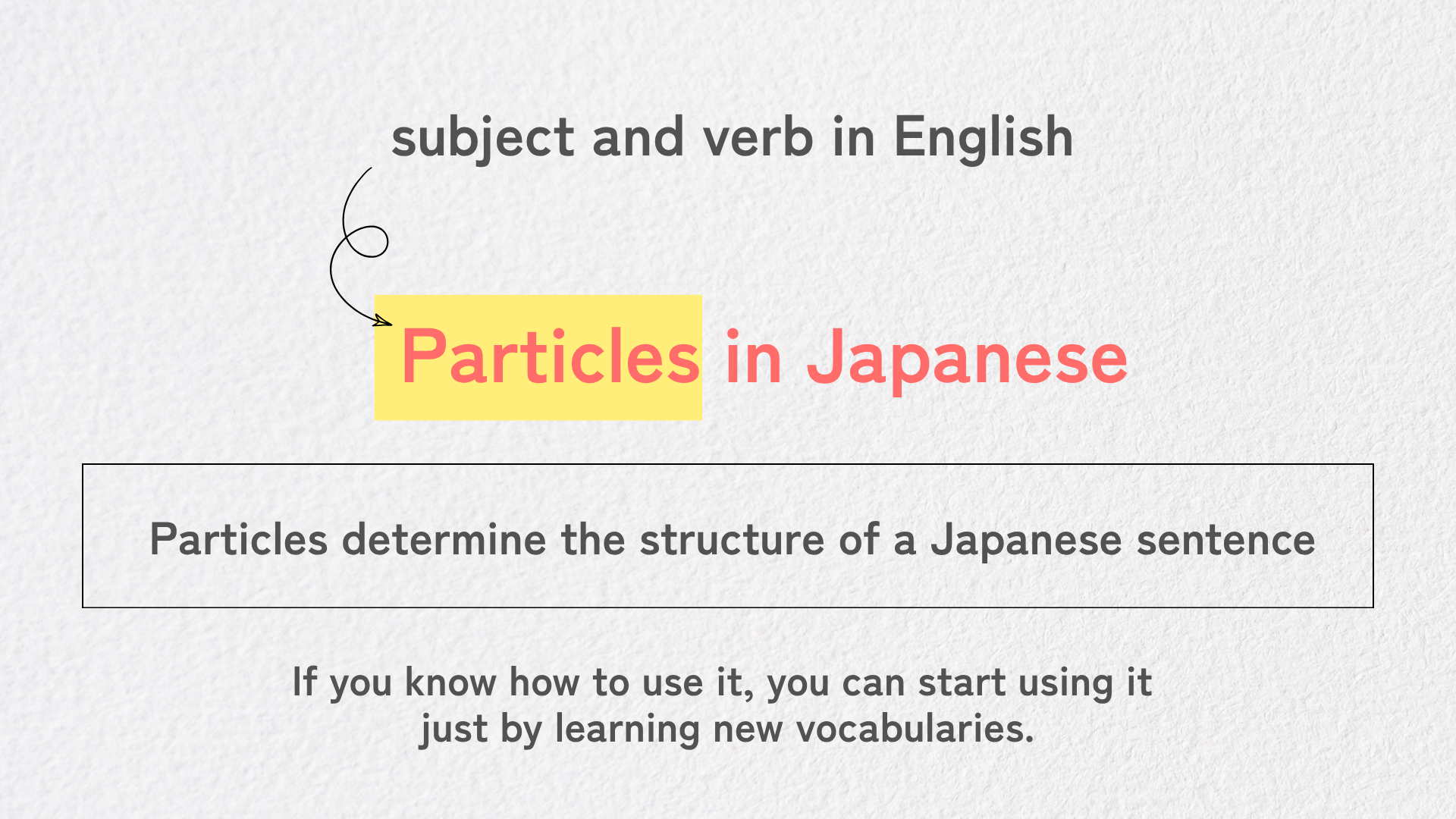
That's why, in my lessons, I put so much focus on particles, and keep trying different approaches to help students get control of them as fast as possible. In fact, once learners start to realize how important particles are, their ability to build sentences on their own suddenly takes off. After around 10 to 20 lessons, many of them can take a few words and, using structures they already know, put those words together into a sentence by themselves.
So if you feel like you've studied Japanese so much but still can't speak it, I really recommend putting more focus on particles from here on. Once you can control the particles, you'll gradually be able to say more and more complex things — just by learning new vocabulary.
One last question for you
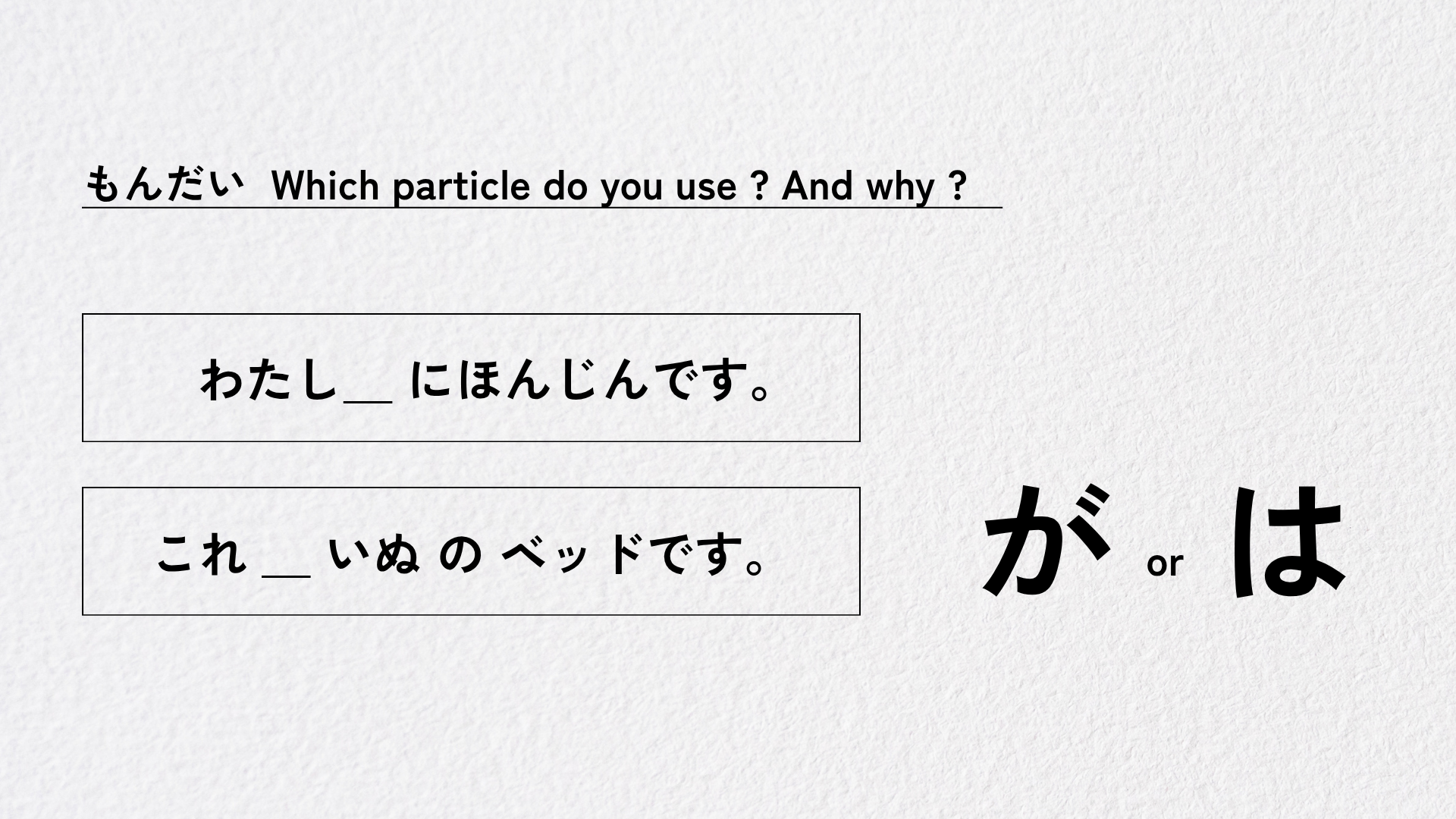
Which marker do you think fits these two sentences better — は or が?
- わたし_ にほんじんです。
- これ_ いぬの ベッドです。
Have a think about which one you'd choose, and why.
Frequently asked questions
What does it mean to "think in Japanese"?
It means building sentences around Japanese structure — especially the particles that mark each part of a sentence — instead of translating from your native language's subject-verb framework.
Why are Japanese particles so important?
Particles act like trail markers. They show the role of each word and guide you toward the predicate at the end of the sentence, so meaning stays clear no matter how long the sentence gets or how much the word order changes.
Is Japanese word order really flexible?
Yes — as long as the predicate comes at the end. Because particles carry the grammatical roles, you can rearrange the other elements and the sentence still makes sense. There is a standard, default word order, of course, but you can adjust it each time depending on what you want to emphasize, or how the sentence connects to what's being talked about.
Why can I study Japanese for years and still not speak it?
Often it's because you're relying on a subject-verb mindset from your native language and skipping over particles, which are what actually hold Japanese sentences together.
If you're not sure how to use は and が, I've put together a detailed explanation of the difference — including why the popular "before/after emphasis" rule can actually be misleading. It's the natural next step from here.
And I've been working on an exercise for training this "thinking in particles" habit, which I'll share soon. For now, start noticing the particles in every sentence you read. That small shift in where you put your attention is where speaking Japanese really begins.