形容動詞「へん(変)」の中心的な意味と副詞的な使い方
This time, I'm bringing you some Japanese-language information aimed at intermediate to advanced learners. I'll also include the English translation at the end, so beginners, please give it a read too:)
へんな形容動詞「へん(変, hen)」
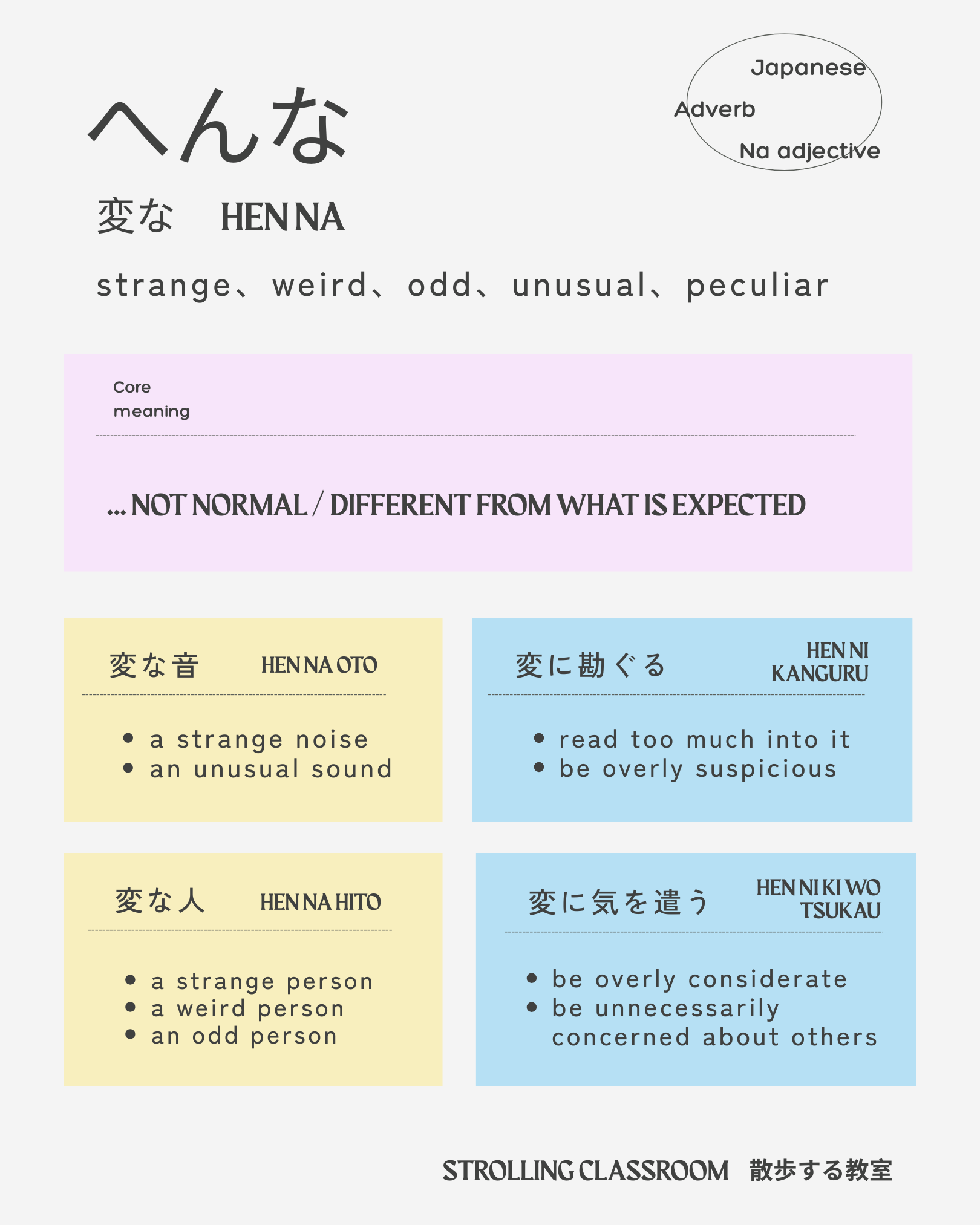
最初は形容動詞の「へん」についてです。「へん(変)」は、weird, awkward, oddというような意味です。
でも、この「へん」が副詞(Adverb)として使われているときは、ちょっとだけ注意が必要です。副詞的に使われるときは、weird, awkward, oddとすこしずれた意味になるからです。
まずは、「へん」の中心的な意味をみてみましょう。「へん」の「へんさ」は、正常・自然・期待される状態から外れていることをさします。
たとえば、食べ物に対して「へんな味がする」といえば、本来予想される味ではない味ですね。ほとんどの場合「おいしくない」、または「くさっている、悪くなっている」ことを表します。へんな味がしたら、食べない方がいいです。
副詞として「へん」が使われるとき、多くの場合、この中心的な意味がよく見えます。
「へんに気をつかう」というと、必要以上に気をつかう、不自然に遠慮するのような意味です。へんの中心的な意味のイメージに沿っています。
「へんに気をつかって、損したわ〜」といえば、「本来はそんなに気をつかう必要がなかったのに、気をつかってしまって、つかれた」というような意味。英語では、I worried/fussed over them in a weird wayよりも、I worried too much about how someone feelsというほうが、ニュアンスとしては近いです。
「奇妙(きみょう, odd/ strange/ peculiar/ bizarre)に執着していた」わけではないと思います。
「へんに気をつかわないで大丈夫だよ、わたし元気だから!」といえば、つらいことがあったけど、友だちを心配させないように振るまっているかんじですね。
- へんに勘ぐる=余計な推測をする(ほとんど悪い方向へ)
- へんに意識する=必要以上に意識する、不自然に気にする
このあたりも、だいたい似たような意味で使われています。
「へんに解釈される」というと、さらに、これまで以上の意味が加わる印象があります。「(主に悪い方向へ)自分のコントロールできない形で、勝手に解釈される」というニュアンスです。
ただ単に、「必要以上に/本来以上に」という意味だけでなく、よりいっそう地に足がついていないイメージですね。
「へんに解釈されるくらいなら、自分から打ち明けたほうがいい」
こういう表現からは、根拠がなく、groundedじゃない状態に感じる不安な気持ちを確定させたい!(打ち明けることは怖いし勇気がいるかもしれないけど)という欲求が感じ取れます。
「へんに期待をさせる」についても、やはり「自分が想定しない形で勝手に期待を持たれる」というニュアンスになります。つまり、あとに続く動詞が受け身(◯◯される)や使役(◯◯させる)になるときには、よりコントロール不可能なニュアンスがたされるのだと思います。
例文たち
「へんに」を副詞的に使った例文をならべると、そのニュアンスがよくわかりますね。英語ではそれぞれ別の表現を当てるものが多いですが、日本語では「へんに」がかなりカバーしてくれます。
ぜひみなさんも、へんにかまえず、「へん」をたくさん使ってみてください:)
- へんに意識する=自意識過剰になる/ 考えすぎる
- to become self-conscious/ to overthink
- へんに遠慮する=遠慮しすぎる
- to be overly reserved/ to hold back unnecessarily
- へんに期待する=期待をしすぎる
- to expect too much
- へんに構える=必要以上に警戒する、力む(りきむ)
- to be overly defensive
- へんに緊張する=必要以上に(通常とは違う形で)緊張する
- to get (unusually and )unnecessarily nervous
English translation
Weird na-adjective [へん(変, hen)]
First up is the na-adjective「へん - hen」. 「へん(変)」means something like weird, awkward, or odd.
But when this「へん」is used as an adverb, you need to be just a little careful — because when it's used adverbially, the meaning shifts slightly away from weird, awkward, odd and strange.
Let's start by looking at the core meaning of「へん」. The "weirdness" of「へん」points to something deviating from a normal, natural, or expected state.
For example, if you say「へんな味がする- hen na aji ga suru」(it tastes weird) about food, you mean a taste that isn't the one you'd normally expect. In most cases it conveys that something doesn't taste good, or that it's gone rotten or bad. If something tastes weird, you're better off not eating it.
When「へん」is used as an adverb, this core meaning is often clearly visible.
Take「へんに気をつかう - hen ni ki wo tsukau」— being considerate more than necessary, holding back in an unnatural way. This stays in line with the image of the core meaning of「へん」.
If you say「へんに気をつかって、損したわ〜 - hen ni ki wo tsukatte son shitawa~」, it means something like: "I didn't really need to be that considerate, but I went and did it anyway, and now I'm worn out." In English, "I worried too much about how someone feels" is closer in nuance than "I worried/fussed over them in a weird way."
I don't think it means you were "strangely fixated (奇妙 - kimyou/odd, strange, peculiar, bizarre) on it."
If you say「へんに気をつかわないで大丈夫だよ、わたし元気だから! - hen ni ki wo tsukawanakute daijoubu dayo. watashi genki dakara!」(Don't go out of your way to worry about me, I'm fine!), it has the feel of someone who's been through something hard but is putting on a front so their friends won't worry.
へんに勘ぐる - hen ni kanguru = to read too much into things / make unnecessary guesses (almost always in a bad direction)
へんに意識する - hen ni ishiki suru = to be conscious of something more than necessary, to mind it unnaturally
These, too, are used with roughly similar meanings.
When you say「へんに解釈される - hen ni kaishaku sareru」(to be interpreted weirdly), a further meaning is added on top of what we've seen so far. It carries the nuance of "being interpreted arbitrarily, in a way you can't control (mainly in a bad direction)."
It's not simply "more than necessary / more than warranted" — it has an even more ungrounded image to it.
「へんに解釈されるくらいなら、自分から打ち明けたほうがいい - hen ni kaishaku sareru kurai nara, jibun kara uchiaketa hou ga ii」("If I'm going to be interpreted weirdly, I'd rather just come out and tell them myself.")
From an expression like this, you can sense the desire to pin down an anxious feeling — the feeling of being in a state that seems baseless, not grounded — even though opening up might be scary and take courage.
The same goes for「へんに期待をさせる - hen ni kitai wo saseru」. It likewise takes on the nuance of "having expectations placed on you arbitrarily, in a way you never intended." In other words, I think that when the following verb becomes passive (to be ◯◯-ed) or causative (to make/let someone do ◯◯), an even more uncontrollable nuance gets added.
Example sentences
When you line up example sentences using「へんに- hen ni」adverbially, the nuance really comes through. In English, each one often calls for a different expression, but in Japanese「へんに」covers quite a lot on its own.
So everyone, without getting weirdly defensive about it (へんにかまえず - hen ni kamaezu), please try using「へん」a lot :)
- へんに意識する - hen ni ishiki suru = 自意識過剰になる/考えすぎる
- to become self-conscious / to overthink
- へんに遠慮する - hen ni enryo suru = 遠慮しすぎる
- to be overly reserved / to hold back unnecessarily
- へんに期待する -hen ni kitai suru = 期待をしすぎる
- to expect too much
- へんに構える - hen ni kamaeru = 必要以上に警戒する、力む
- to be overly defensive
- へんに緊張する - hen ni kinchou suru = 必要以上に(通常とは違う形で)緊張する
- to get (unusually and) unnecessarily nervous