A Guide to Learning Kana: Practice Sheet Archive and Study Tips
Key points for learning kana, all my hiragana and katakana practice sheets in one archive, and where kana come from: 万葉仮名 (Man'yougana).
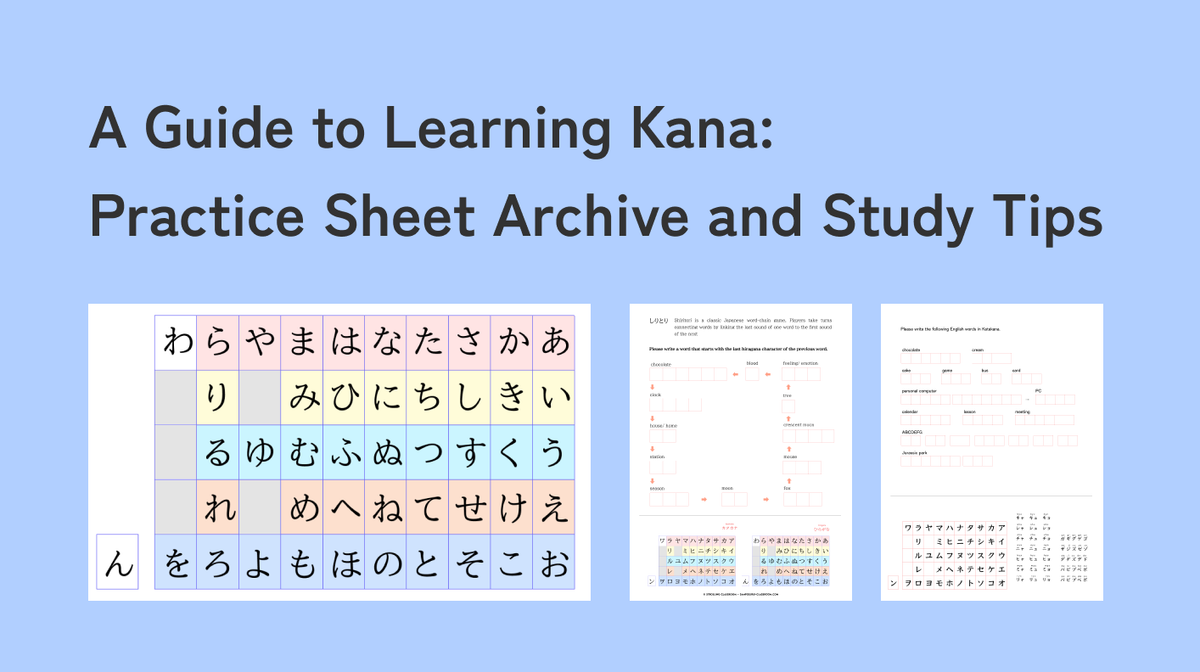
Hiragana and Katakana are the very foundation of how Japanese characters relate to sounds. In this article, I've gathered the key points for learning kana, along with the practice sheets I've sent out in the newsletter so far. Whether you're just starting out or want to review, please use it as your starting point.
Key points for learning kana
Overall: first, look at the kana chart
Before memorizing kana one character at a time, first look at the whole chart, the 五十音 (Gojuuon, literally "fifty sounds") chart.
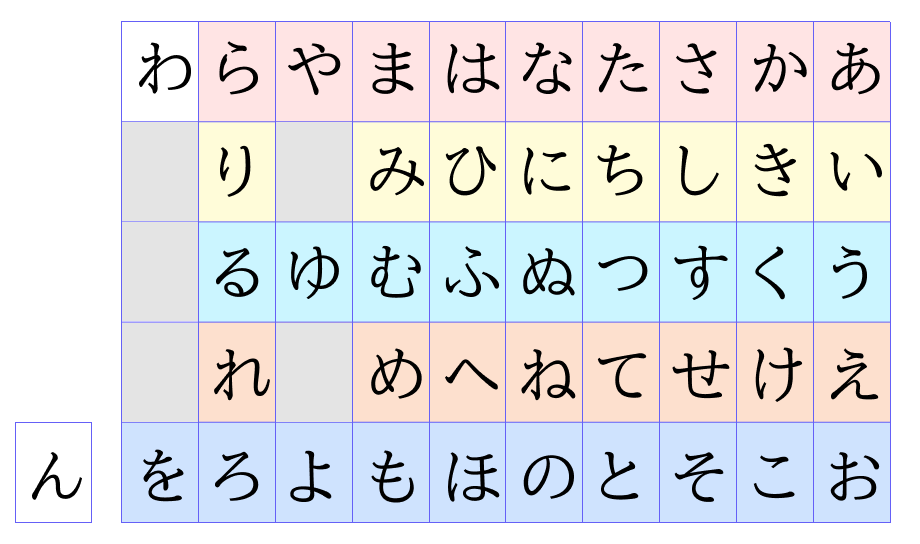
Japanese characters are made up of combinations of consonants and vowels.
What matters is not rote memorization, but grasping the relationship between characters and sounds as a physical, intuitive sense.
This is also why I've included chart practice in our learning app. This sense becomes the foundation for both pronunciation and vocabulary.
It's also important to recognize the rows of the chart vowel by vowel, like あかさたなはまやらわ (a ka sa ta na ha ma ya ra wa).
When practicing by writing
In addition to the 五十音 chart, I recommend searching online for materials made for Japanese elementary school children.
In Japan, a great many children learn Hiragana and Katakana every year. The number of learners is on a completely different scale, and there is a long history of refining how to teach them. That is exactly why these materials are of high quality overall.
If you search for terms like 「ひらがな 練習 プリント 小学1年生」 (hiragana practice printables for first graders) , and you'll find plenty that you can print for free:)
My practice sheet archive
Hiragana & Katakana
- Kana chart fill-in
- Word search
Hiragana
- 拗音 (Youon, sounds written with a small ゃ, ゅ or ょ)
- Counters: さつ (satsu), ほん (hon), ひき (hiki), まい (mai)
- Everyday words: body, nature and town
- しりとり (Shiritori, a word-chain game)
Katakana
- Katakana that look alike
- Katakana words
When studying on your phone
I recommend flick input.
The flick keyboard has あかさたなはまやらわ (a ka sa ta na ha ma ya ra wa) laid out on it, and the sound changes to い (i), う (u), え (e) or お (o) depending on the direction you flick the key.
It's also important to recognize each row by its vowel, as in あかさたなはまやらわ.
On both iPhone and Android, you can use it by adding the Japanese kana keyboard in your keyboard settings.
万葉仮名 (Man'yougana): Where Hiragana and Katakana Come From
Hiragana and Katakana were both born from kanji. What they came from is 万葉仮名 (Man'yougana).
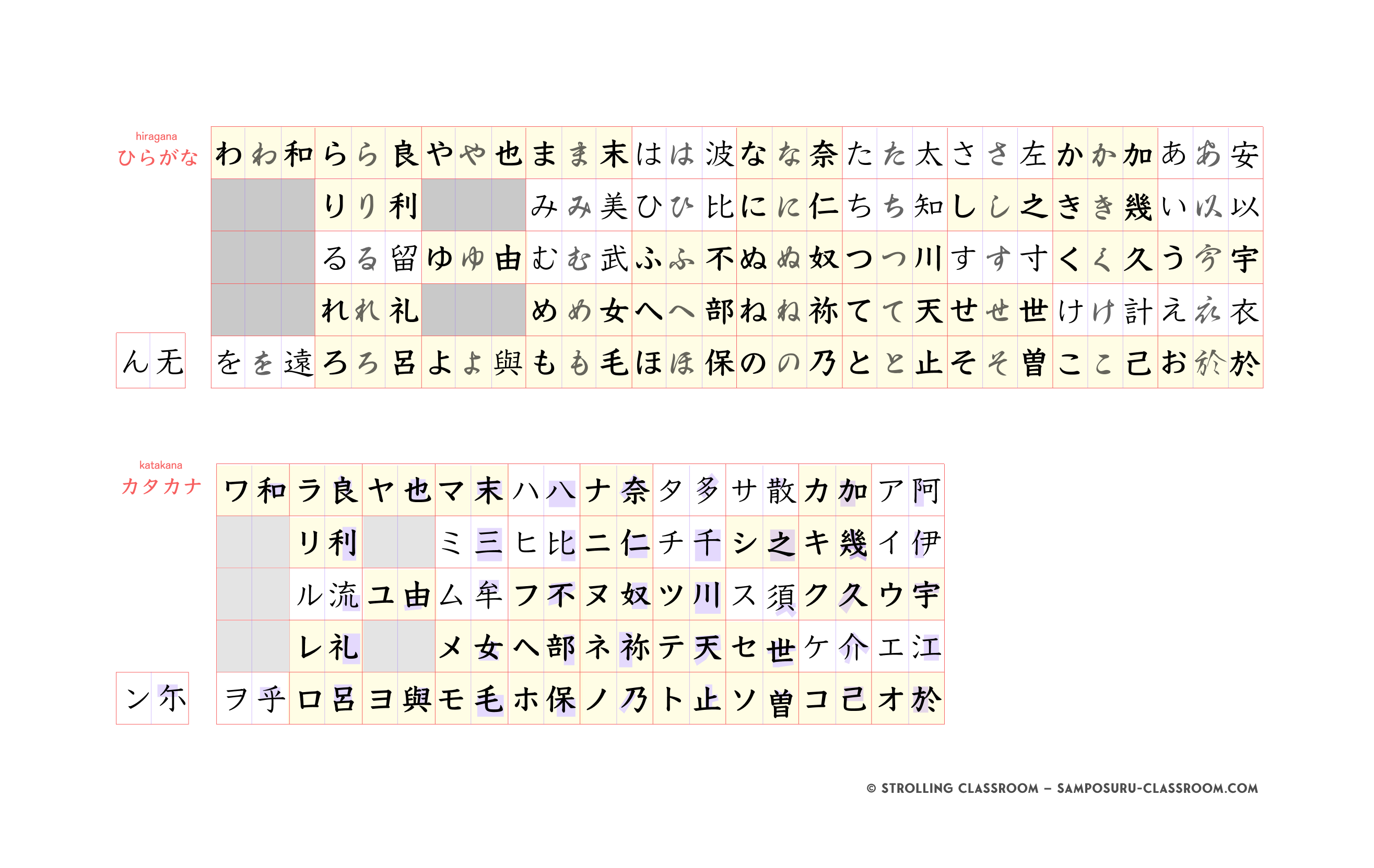
万葉仮名 is a way of writing Japanese by borrowing only the sound of a kanji, not its meaning. For example, 安 is a kanji that means やすい (yasui, cheap), but in 万葉仮名 that meaning was not used: it was used to write the sound あ (a).
The name comes from 『万葉集』 (Man'youshuu), a collection of poems compiled around the 8th century, in which this way of writing was used a great deal.
Hiragana were born from forms in which the 万葉仮名 kanji were written in a loose, cursive way.
安 → あ (a)
以 → い (i)
宇 → う (u)
Katakana were born by taking one part of a 万葉仮名 kanji.
阿 → ア (a)
伊 → イ (i)
宇 → ウ (u)
う and ウ were both born from the same kanji, 宇. Even from the same kanji, writing it in a cursive way gives you Hiragana, and taking one part of it gives you Katakana.